Who Are The Houthis?
Oct 24th, 2026 | By Dr. Jim Eckman | Category: Featured Issues, Politics & Current EventsThe mission of Issues in Perspective is to provide thoughtful, historical and biblically-centered perspectives on current ethical and cultural issues.
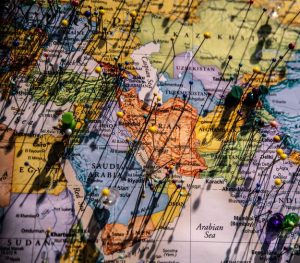
Back in February, when the United States and Israel went to war with Iran, most of us did not know much about the Houthis, that stateless militia in Yemen backed by Iran, let alone the straits on either side of the Arabian Peninsula. Now Iran and its Houthi allies control the two main routes for shipping oil out of the Middle East—the Persian Gulf and the Red Sea.
The Houthis started out in the 1990s as a religious movement in northern Yemen that became a motley group of Islamist fighters waging civil war against the government in the 2010s. They believe their power emanates from God. They declare death to America and Israel and “a curse upon the Jews.” Supplied by Iran, they battled a Saudi-led coalition until the United Nations brokered a fragile peace in Yemen in 2022. The following year, they started attacking shipping in the Red Sea. As Sam Sifton of the New York Times counsels, “Keep an eye on the Houthis, then. A former U.S. special envoy for Yemen was blunt about them . . . ‘They use every opportunity to build their capability, to test their capability, such that they are now the most lethal nonstate actor in the entire Middle East,’ he said.”
Who are the Houthis and how have they become one of the most dynamic and powerful militias in the Middle East?
The Houthis, officially named Ansar Allah (Supporters of God), are an armed political and religious group that controls northern Yemen and the capital city of Sanaa. It is named after its early leader, Hussein Badr al-Din al-Houthi and began in the 1990s in Yemen’s northern Saada province. They practice Zaidism, a branch of Shia Islam that makes up about one-third of Yemen’s population. Their official motto states: “God is great, death to America, death to Israel, a curse upon the Jews, victory to Islam.”
The Houthis took over the Yemeni capital Sanaa in September 2014 and seized control over much of north Yemen by 2016. Yemeni officials and Sunni states have repeatedly alleged that Iran and its proxy Hezbollah have provided arms, training, and financial support to the Houthis.
The Wilson Center has provided a most helpful summary of the Houthis, which I want to draw on in this Perspective.
- The Houthi movement emerged in northern Yemen in the 1990s, in part, as a reaction to rising Saudi financial and religious influence. In November 2009, the Houthis crossed into Saudi Arabia amid their rebellion against Yemen’s central government. The Saudis launched air strikes against the rebels and engaged in ground skirmishes. More than 130 Saudis died. The next major round of Saudi-Houthi fighting began in March 2015. A coalition led by Saudi Arabia and the United Arab Emirates (UAE) launched airstrikes against Houthi targets in Yemen. The war between the Houthis and Yemen’s internationally recognized government and its supporters dragged on. This struggle between the Houthis and Saudi Arabia also continues.
- The Houthis are a large clan originating from Yemen’s northwestern Saada province. They practice the Zaydi form of Shiism. Zaydis make up around 35% of Yemen’s population. Like other Shiites, Zaydis believe that only descendants of the Prophet Mohammed’s cousin and son-in-law, Ali, have the right to lead the Muslim community as imams—divinely-appointed successors of the Prophet. A Zaydi imamate ruled Yemen for 1,000 years, before being overthrown in 1962. Since then, the Zaydis—stripped of their political power—have struggled to restore their authority and influence in Yemen. Houthi insurgents have clashed with Yemen’s government for more than a decade. Since 2011, the Houthi movement has expanded beyond its Zaydi roots and become a wider movement opposed to the central government. The insurgents have also begun referring to themselves as Ansarullah, or “Party of God.”
- Iranian officials have supported the Houthis’ cause: “Iran supports the rightful struggles of Ansarullah in Yemen and considers this movement as part of the successful Islamic Awakening movements,” Ali Akbar Velayati, a senior advisor to Supreme Leader Khamenei, said in October 2014. But Tehran has repeatedly denied providing arms, funds or training to the Houthis. Saudi Arabia has long accused Iran of arming the Houthis to fight a proxy war. “We are worried about…the tendencies of Iran in the region, which is one of the leading elements implanting instability in the region,” the late Saudi Foreign Minister, Prince Saud al Faisal, said in 2015.
- What is the relationship between Houthis and other Islamists in Yemen? The Houthis have a tense relationship with Islah, a Sunni Islamist party with links to the Muslim Brotherhood. Islah claims the Houthis are an Iranian proxy, and blames them for sparking unrest in Yemen. But clashes between the Houthis and Islah continued. In the first four months of 2015, the Houthis kidnapped dozens of Islah party leaders and raided their offices. By April, more than 100 Islah leaders were detained by the Houthis. Tensions increased after Islah declared support for the Saudi-led airstrikes. The Houthis are also at odds with Sunni extremist groups. On 20 March 2015, an ISIS affiliate calling itself the Sanaa Province claimed responsibility for suicide bomb attacks on two Zaydi mosques that killed at least 135 people and injured more than 300 others.
Recently, The Economist provided a helpful perspective about Houthi activity in the Red Sea area. In 2015 the Houthis swept into the port city of Mokha on Yemen’s west coast. They put missiles on nearby Perim island, a rocky outcrop at the mouth of the Red Sea. Gulf rulers feared the Houthis might use that foothold to threaten shipping through the Bab al-Mandab strait of the Red Sea. The Gulf states’ Yemeni allies retook the island six months later. In 2017 the Houthis lost Mokha as well. On 10 September 2026 the Houthis once again seized Mokha. Perim fell to them the next day. They faced little resistance: anti-Houthi forces fled the battle. It was their largest advance since 2022, when a ceasefire froze the front lines. They are now preparing offensives against the city of Taiz and on Marib, a north-eastern province and the hub of Yemen’s oil industry.
“This is a humiliation for Saudi Arabia, the main foreign backer of the anti-Houthi coalition. It is also a boost for Iran in its war with America. With the Strait of Hormuz largely shut since February, the Red Sea has been a vital conduit for Saudi oil exports. Now Iran and its allies can threaten that waterway too. Brent crude climbed by more than 6% after the Houthi offensive, to over $109 a barrel. Still, this is one battle in a civil war that has lasted 12 years and often trends towards stalemate. The Houthis have made swift advances before, only to find themselves unable to hold what they have seized. And the impact on oil markets may be partly offset by increased exports through Hormuz, where America’s navy has been escorting tankers to safety.”
“Iran has reacted with glee. Kayhan, a hardline newspaper, said America had suffered ‘another defeat in the war of the waterways.’ The Saudis are desperate for help. ‘This demands international support, not only from Saudi Arabia and regional countries,’ wrote Abdulrahman al-Rashed, a columnist close to the royal court. They have received little. America has military advisers in Saudi Arabia to help with targeting, but Donald Trump declined requests from Muhammad bin Salman, the crown prince, to launch air strikes of his own. A long campaign would probably require him to divert one of two aircraft-carrier groups stationed near the Strait of Hormuz, weakening its blockade of Iranian ports. The Houthi advance was not the only calamity to befall Saudi Arabia . . . . On September 11th drone attacks forced it to close its main oil pipeline, which transports crude from fields in the east to ports in the west. The kingdom blamed Iraqi militias for the attack (though no one has claimed responsibility). It has now cancelled some scheduled deliveries to European customers, leaving them to scramble for alternative suppliers.”
“This looks like an enviable position for Iran: its allies can threaten the flow of oil both within Saudi Arabia and through the Red Sea. On the other side of the Arabian peninsula, though, more and more tankers are slipping through Hormuz under American protection. Some are making the journey in daylight, suggesting that Iran’s ability to hit moving targets has diminished . . . Iran is tightening its hold on one strategic waterway just as America unwinds its grip on another. Both the war in Yemen and the wider war in the Gulf are far from over.”
The chaos in the Middle East has caused me to think biblically about this region. The prophetic Scriptures in Daniel chapters 9 and 11-12 and in Revelation 12-14 speak of powers to the north and to the immediate east of Israel. [“Gog and Magog” may refer to these geographic areas.] A resurgent Russia under Putin and a resurgent Persia under Iran fit this description perfectly. Furthermore, as one studies prophetic Scripture, one struggles to find any reliable section that even remotely refers to the Western Hemisphere, specifically to North America. The world order put together by the United States after World War II is coming apart. Who is filling that vacuum created by US withdrawal? In the East it is clearly China. In the Middle East it is clearly Russia and to some extent Iran.
Since 1945, the US has been the arbiter of a “rules-based” world order, but no longer. The war in Ukraine should cause the US in 2026 to once again assume leadership in countering the brutality of Russia. Europe, for example, is more united than it has been since the dangerous days of the Cold War in the early 1950s, but the US under President Trump no longer regards Europe as a friend or ally. Trump seems to more and more favor Putin over European leaders.
The new world order that is emerging centers on Russia, China and Iran challenging the world order organized by the US after World War II. It is also a challenge that focuses on democracy versus authoritarian dictatorship. Putin, Xi and Khamenei’s son, the new Iranian ruler, argue that democracy does not work. People, they argue, are willing to surrender their rights in exchange of order and stability. If the US in years to come chooses to ignore or dismantle the alliances of post-World War II (e.g., NATO) and further embraces protectionism, the forces of authoritarianism will succeed to a degree. The US is the only nation that serves as a buffer against the forces of evil represented by Russia, China and Iran. In many ways, the US is facing unchartered waters. As Christians, we must engage in fervent prayer for our leaders, regardless of the political party they represent. 1 Timothy 2:1-6 become critically important verses for the Christian in 2026. May we be people who pray diligently and not people who only criticize, grumble and complain. We are ambassadors of our king, the Lord Jesus. May we represent Him well in this challenging and difficult unraveling of the old world order and the emergence of the new.
See Sam Sifton in the New York Times “The Morning” (16 September 2026); “Who are Yemen’s Houthis?” Wilson Center (7 June 2022); and The Economist (19 September 2026), p. 42