God, Cosmology And Human Understanding
Apr 25th, 2026 | By Dr. Jim Eckman | Category: Culture & Wordview, Featured IssuesThe mission of Issues in Perspective is to provide thoughtful, historical and biblically-centered perspectives on current ethical and cultural issues.
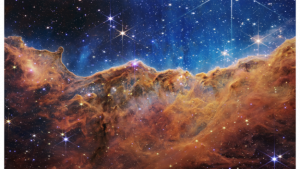
Image credit: NASA, ESA, CSA, and STScI
One of my hobbies is astronomy. When I retired from higher education in 2012, my wife bought me a telescope. Studying the stars and the planets is breathtaking. But beyond my amateurish investigations, I love to view the amazing photos provided by NASA from the Hubble Telescope and now the James Webb Space Telescope. The beauty, scale and sharpness of these photos are magnificent. And when I realize that these stars, galaxies and nebula are millions of light years away, I am drawn to King David’s affirmation, “The heavens declare the glory of God; the sky above proclaims His handiwork” (Psalm 19:1, ESV).
Astrophysicist Deborah Haarsma reminds us of two scientific facts (what is called the Standard Model):
- The vastness of the universe: The visible universe contains hundreds of billions of galaxies — each of which contains billions or trillions of stars.
- But the universe is not only stars. In fact, much of the universe we do not understand: Scientists have calculated that 27% of the universe is “dark matter,” which we only detect through its gravitational effect, and 68% is “dark energy,” a mysterious substance that has to do with how the universe expands. Therefore, scientists can only explain 5% of the universe (e.g., the stars and all the elements on the periodic table). For the remaining 95%, science has no explanation.
Yet, in the vastness of this universe with all of its “unknowns,” there is Earth. As Paul Sutter observes, “Earth is the only known place where humanity exists — where humanity can exist. It is the only known place where laughter, love, anger and joy exist. The only known place where we can find dance, music, art, politics and cosmology.” All of this begs the question of how this inconceivable vastness and mystery relates to me, a human being living on a tiny speck in this vastness called Earth. This vastness does not diminish God or make Him irrelevant; it demonstrates His immense power, His glory and His grace. He created all this vastness, yet His attention is focused on humans who inhabit this speck called Earth.
Those who reject God’s revelation in Scripture and the proposition that He is the Creator of all things, often embrace despair and hopelessness because we really understand only 5% of the universe. As one writes, “the universe remains random, empty, cold. We’re alone in the dark, nothing means anything until we give it meaning, and death is the end. These are comfortless facts, but I’ve come to accept and even, at times, embrace them, with no desire to disenchant anyone else.”
Such difficult concepts are a part of the discipline called cosmology. “Cosmology is not like other sciences. It’s not like studying mice in a maze or watching chemicals boil in a beaker in a lab. The universe is everything there is; there’s only one and we can’t look at it from the outside. You can’t put it in a box on a table and run controlled experiments on it. Because it is all-encompassing, cosmology forces scientists to tackle questions about the very environment in which science operates: the nature of time, the nature of space, the nature of lawlike regularity, the role of the observers doing the observations.”
As The Economist reports, “The study of dark energy is surprisingly new. Direct evidence for its existence was not detected until 1998, when scientists discovered that extremely bright exploding stars called supernovas were moving away from Earth much more quickly than they ought to. Their conclusion: not only was the universe expanding, but that expansion was accelerating. Because it is hard to study directly, the true nature of dark energy remains poorly understood. The leading hypothesis is that it is energy intrinsic to the vacuum of empty space. Per quantum theory, a vacuum is not really empty, it fizzes with countless pairs of particles and antiparticles that emerge from nothing, only to annihilate each other.”
“Dark energy now forms one of two central pillars of the standard model of cosmology, the best scientific description of the universe’s evolution. The other pillar is dark matter, an invisible form of matter that makes up 27% of the universe. Regular matter, which constitutes stars and galaxies, accounts for a measly 5%. The standard model says that, after the Big Bang set the universe’s expansion in motion, the gravitational attraction between atoms first led to the formation of stars and galaxies, while also acting as a brake on the universe’s overall growth. As the amount of empty space increased, however, so did the amount of dark energy and, eventually, it took over as the primary influence on the evolution of the cosmos.”
In the 1962, Thomas Kuhn wrote a profoundly important book, The Structure of Scientific Revolutions, in which he introduced the concept of “paradigm shift” into the study of scientific models. “That has certainly been the case in the past with scientific breakthroughs like Copernicus’s heliocentrism, Darwin’s theory of evolution and Einstein’s relativity. All three of those theories also ended up having enormous cultural influence — threatening our sense of our special place in the cosmos, challenging our intuition that we were fundamentally different than other animals, upending our faith in common sense ideas about the flow of time. Any scientific revolution of the sort we’re imagining would presumably have comparable reverberations in our understanding of ourselves.” It would seem that we are in the midst of one of the paradigm shifts when it comes to cosmology.
Astrophysicists Adam Frank and Marcelo Gleiser recently explained the current “crisis in cosmology”: “Not long after the James Webb Space Telescope began beaming back from outer space its stunning images of planets and nebulae last year, astronomers, though dazzled, had to admit that something was amiss. Eight months later, based in part on what the telescope has revealed, it’s beginning to look as if we may need to rethink key features of the origin and development of the universe. Launched at the end of 2021 as a joint project of NASA, the European Space Agency and the Canadian Space Agency, the Webb, a tool with unmatched powers of observation, is on an exciting mission to look back in time, in effect, at the first stars and galaxies. But one of the Webb’s first major findings was exciting in an uncomfortable sense: It discovered the existence of fully formed galaxies far earlier than should have been possible according to the so-called standard model of cosmology.”
- “According to the standard model, which is the basis for essentially all research in the field, there is a fixed and precise sequence of events that followed the Big Bang: First, the force of gravity pulled together denser regions in the cooling cosmic gas, which grew to become stars and black holes; then, the force of gravity pulled together the stars into galaxies. The Webb data, though, revealed that some very large galaxies formed really fast, in too short a time, at least according to the standard model. This was no minor discrepancy. The finding is akin to parents and their children appearing in a story when the grandparents are still children themselves.
- Take the matter of how fast the universe is expanding. This is a foundational fact in cosmological science — the so-called Hubble constant — yet scientists have not been able to settle on a number. There are two main ways to calculate it: One involves measurements of the early universe (such as the sort that the Webb is providing); the other involves measurements of nearby stars in the modern universe. Despite decades of effort, these two methods continue to yield different answers.
- Physicists and astronomers are starting to get the sense that something may be really wrong. It’s not just that some of us believe we might have to rethink the standard model of cosmology; we might also have to change the way we think about some of the most basic features of our universe — a conceptual revolution that would have implications far beyond the world of science.”
Michael Guillen, a Harvard physicist and former ABC News Science Editor (1998-2002) who became a Christian, writes, “When I was an atheist . . . my worldview rested on the core axiom that seeing is believing. When I learned that 95% of the cosmos is invisible, consisting of ‘dark matter’ and ‘dark energy,’ names for things we don’t understand, that core assumption became untenable. As a scientist, I had to believe in a universe I mostly could not see. My core axiom became ‘believing is seeing.’” He goes on, “science’s worldview is becoming more mystical, not less. Witness supernatural-like concepts such as virtual particles, imaginary time and quantum entanglement . . . Faith is the foundation of the entire human experience—the basis for both science and religion. Our faith in physical reality drives us to seek treatments for deadly diseases like COVID-19, to explore the depths of the sea, to invent the perfect source of energy. Our faith in spiritual reality drives us to create breathtaking works of art, music, and architecture; to see life as a divine creation, not an accident of nature; to be curious about things that are not of this world. . . Faith is anything but a weakness. It is the mightiest power in the universe.”
In a most helpful article on the Standard Model and the “theory of everything,” The Economist writes, “What physics no longer has, though, is an all-embracing model of the future to try to fit everything into . . . For the moment, fundamental physics is back a pragmatic phase, gathering more pieces of the jigsaw in the hope of fitting them together later. Physicists have by no means abandoned the lofty goal of unifying forces and creating a grand theory that encompasses everything. But they need a new map to get there.”
The “new map” The Economist calls for should begin with faith, faith in a God who has revealed Himself to humanity. His revelation is necessary for us to know Him because we are so different from Him. In terms of capacity, God is infinite and we are finite. In terms of nature, He is holy and we are sinful. As Rick Cornish writes, “God is inaccessible without His accommodating Himself to us by revealing Himself. We cannot know God or relate to Him unless He reveals Himself.”
The Bible makes it clear that God created the universe out of nothing (see Genesis 1:1; Psalm 33:6, 9; John 1:3; Hebrews 11:3, etc.). Because God created everything out of nothing, matter is not eternal. God did not simply reshape existing matter; He created everything from nothing (ex nihilo). Therefore, the universe has purpose and meaning. God is not part of His creation, for He made it and rules over it. He is above (i.e., transcendent) and independent of His creation. But God is not an absentee landlord, so to speak; He is intimately involved in His creation. Indeed, His creation is continually dependent on Him for its existence and its functioning. The Bible is the story of God’s involvement with His creation, providentially accomplishing His purposes and sustaining His creation (Acts 17:25, 28; Colossians 1:17). Isaiah 43:7 also demonstrates that the physical world was created for God’s glory. When we view the Webb telescope photographs, we naturally ask, “Who could have made all this? Who could make it out of nothing? Who has sustained these galaxies and star dust clusters for these endless years?” As Wayne Grudem concludes, “Such infinite power, such intricate skill, is completely beyond our comprehension. When we meditate on it, we give glory to God.” Because God has given humanity dominion authority over His world (see Genesis 1-2 and 9), we have the desire to discover and master our physical world. The Webb telescope illustrates this truth.
What theologians call God’s general revelation is found in creation, both in nature (Psalm 19:1-4; Romans 1:18-25) and in human beings created in God’s image with a conscience (Romans 2:14-16). The content of this general revelation reveals broad truths about God—His existence, his power and that He is the creator. Our inability to understand everything in the universe does not mean that God is the author of confusion or chaos. The presence of mysteries or paradoxes does not mean that God is incomprehensible or that His world is incomprehensible. He further has revealed Himself in His special revelation, His written Word. Based on our study of His creation and His Word, we can posit the following propositions:
[1] God is the sole originating source of everything; He is ultimate and sovereign.
[2] The universe is not eternal; it had a beginning.
[3] Nothing, either material or spiritual, exists apart from God.
[4] Everything has value because God made it and pronounced it good.
[5] Scientific study of the universe is possible—and will bring glory to God as the Creator.
See Debroah Haarsma, “The Incarnation According to Astrophysics” in Christianity Today (November/December 2025), pp. 34-37; Adam Frank and Marcelo Gleiser “The Crisis in Cosmology” in the New York Times (3 September 2023); The Economist (22 June 2024), pp. 72-73; Paul M. Sutter, “The Emptiness of the Universe Gives Our Lives Meaning” in the New York Times (10 November 2024); William E. Carroll, “Aquinas and the Big Bang” in First Things (November 1999); George F. Will, “The Webb Space Telescope is telling humanity the history of everything” in the Washington Post (27 January 2023); Wayne Grudem, Systematic Theology, pp. 262-272; Katie Mack’s review of The Elephant in the Room in the Wall Street Journal (9-10 July 2022); The Economist (9 July 2022), pp. 75-7; James P. Eckman, The Truth about Worldviews, pp. 17-26; Rick Cornish, 5 Minute Theologian, pp. 49, 109-110; and Michael Guillen in the Wall Street Journal (24 September 2021).